
Disclaimer: This is user feedback based on personal experience. It's inherently limited without access to Meta's internal data, product priorities, or technical constraints.While travelling in the past 2 weeks & discovering so many new places every day, I kept repeating one small ritual. I’m sitting in a restaurant. I hate to order from plain text menu. I open Instagram to see what the food actually looks like.
Most restaurants have generic names. “Central Café” might exist in ten cities. Instagram knows exactly where I am. It has both my location permission and my IP address. I’m literally inside the restaurant. Yet when I search, Instagram returns five different accounts from Paris, New York, Buenos Aires. Not the one I’m sitting in because the search is not location-aware.
Instagram became the world’s largest visual database of places. Billions of geotagged posts. Engagement signals on every restaurant, café, museum, and attraction on the planet. People already use Instagram as a food guide, a travel guide. They just do it inefficiently.
What Instagram should build
Instagram Maps needs two things: better search when you’re already somewhere, and better discovery when you’re deciding where to go.
The “I’m Here” button
The first thing Instagram should have is an explicit “I’m here” mode. In that mode, results are local by default. The place you’re in comes first. Nearby places next. Ranked not by stars, but by what’s happening now—recent posts, real people, signals that already exist.
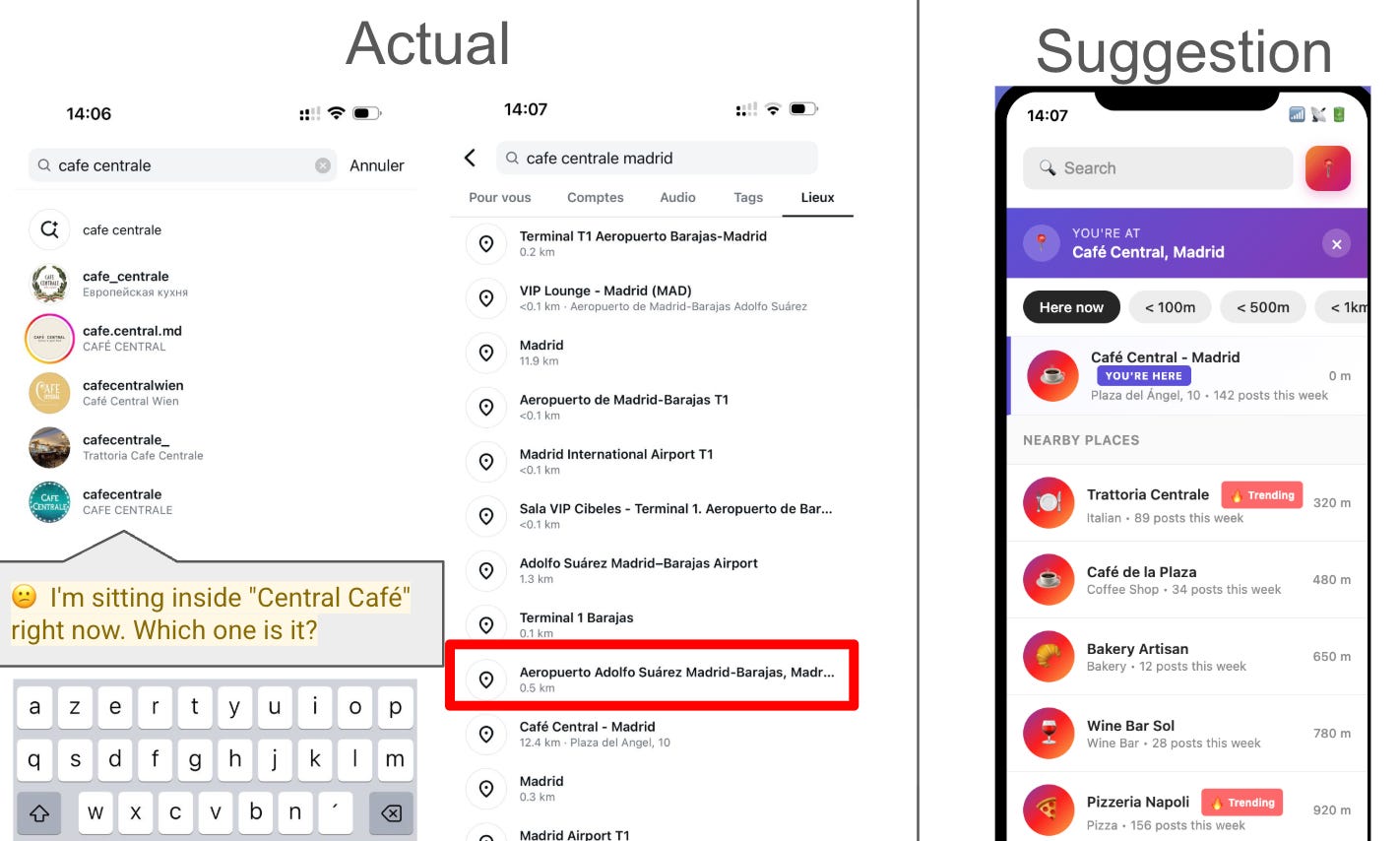
Low-fidelity Mock-up done with Claude - One tap. No typing. No scrolling through wrong accounts. Just instant access to where you are.
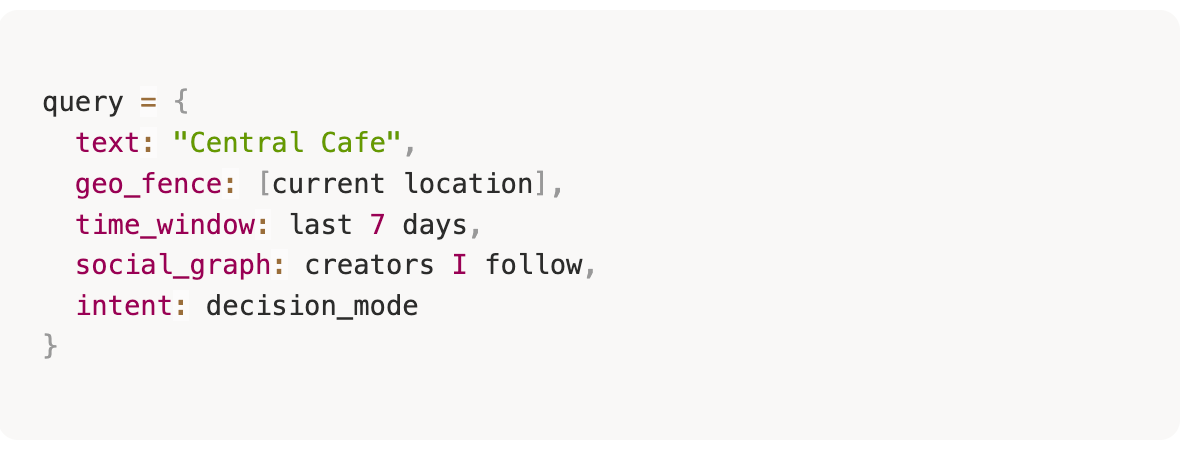
Today, Instagram search is one-dimensional. When I search “Central Café,” everyone sees the same results regardless of location. Rankings are based on global popularity, account authority, and engagement velocity. This works for most use cases. But local businesses need context-aware search.
Beyond the UI, it's a different kind of search entirely. Technically, Instagram's search should classify every query & label it as a person/celebrity, hashtag, product/brand, location, or business & then route the user to the appropriate search experience.
Make Maps feel decisive
The second thing is to finish what Instagram Maps almost is. Maps today feel exploratory, like something you stumble into. They should feel decisive. Opening a map should mean you’re no longer browsing content. You’re making a choice.
Google Maps tells you a restaurant has 4.2 stars. Instagram Maps would show you: “This place is trending this week. Here are 47 recent posts. Three creators you follow have been here. This is what it looks like.” That’s a different kind of answer. Google Maps tells you what is good in general. Instagram can tell you what feels good to you.
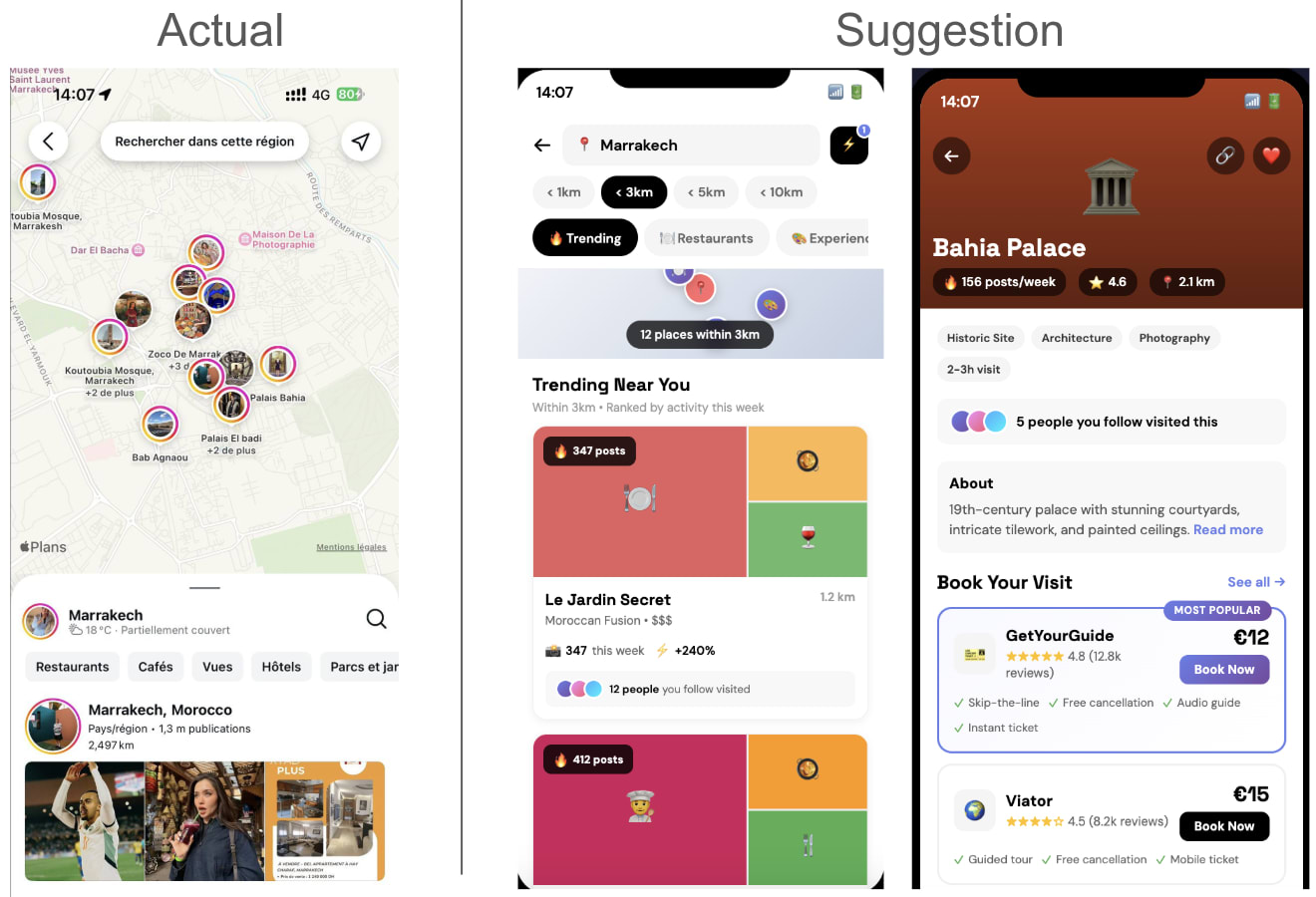
Low-fidelity Mock-up done with Claude
Why Meta should care
Much of Instagram usage happens outside the home, during real decision moments. Location-based intent is one of the highest-value user states in consumer products. When someone opens Instagram Maps, they’re not killing time—they’re choosing where to go. That’s the rarest and most valuable moment for a local business, and Meta is leaving money on the table.
Right now, Google owns local intent. Booking.com spends most of its ad budget on Google. GetYourGuide does the same. They’re all paying Google to capture people at the moment of decision. Instagram could redirect a massive chunk of that spend. If a restaurant or tour operator could pay Meta directly when someone discovers them on Instagram Maps and walks through the door, why would they keep paying Google for search ads?
Google already built this. Their Performance Max for in-store sales lets local businesses pay when shoppers actually visit their store. Retailers upload inventory to Merchant Center, run campaigns, and only pay when customers walk through the door. The infrastructure exists, the measurement works, and businesses are paying for it. Instagram has better content, better engagement data, and younger audiences. They just haven’t built the monetization layer.
TikTok is moving aggressively into discovery. Short-form video recommendations for restaurants and places are becoming standard. Instagram needs defensible territory, and location is an area where its decade of geotagged content gives it an enormous advantage.
The business model Meta is ignoring
Instagram Maps doesn’t just need better UX. It needs a new monetization strategy. Today, Meta’s advertising runs on CPC (cost per click) or CPM (cost per thousand impressions). Feed ads generate billions.
Current model: User scrolls feed for 30 minutes, sees 20 ads at $5 CPM = $0.10 revenue per session
Maps model: User opens Maps once, finds a restaurant, Instagram charges $3–5 for verified visit = $3–5 revenue per session
That’s a 30–50x improvement in revenue per minute of engagement. A restaurant ad while I’m scrolling through Stories at 11pm has the same pricing as an ad when I’m actively looking for lunch spots near me. Google makes more money per search than Meta makes per scroll. Instagram Maps could be Instagram’s search moment.
1. Cost Per Visit
Instead of paying when someone taps your ad, you pay when they actually walk through your door within 7 days of seeing your listing on Instagram Maps. Meta already has the technology to track store visits using anonymized location data. The restaurant doesn’t pay for curiosity—they pay for real customers.
A Cost Per Visit ad is worth 10–50x more than a scroll-through impression. One high-intent Maps session could generate more revenue than an hour of mindless scrolling.
2. Embedded Affiliation
Partner with booking platforms like GetYourGuide and OpenTable. When users discover an experience or restaurant on Instagram Maps and book through the app, Instagram takes a cut. This is exactly what TikTok is building. Instagram is handing it to them.
The bottom line
Instagram is trading dollars for pennies. The platform doesn’t want users to leave with a decision. It wants them to stay and scroll. Maps that work too well would reduce session time. But there’s a choice: optimize for CPM × Time Spent or Outcome × Intent. Sometimes value beats volume. People already use Instagram to find restaurants. Instagram just needs to make it work.
All the pieces exist: location data, geotagged posts, foot traffic tracking, billions of photos. The behavior is already there. What’s missing is the willingness to build sometimes for high-intent moments instead of endless scrolling.
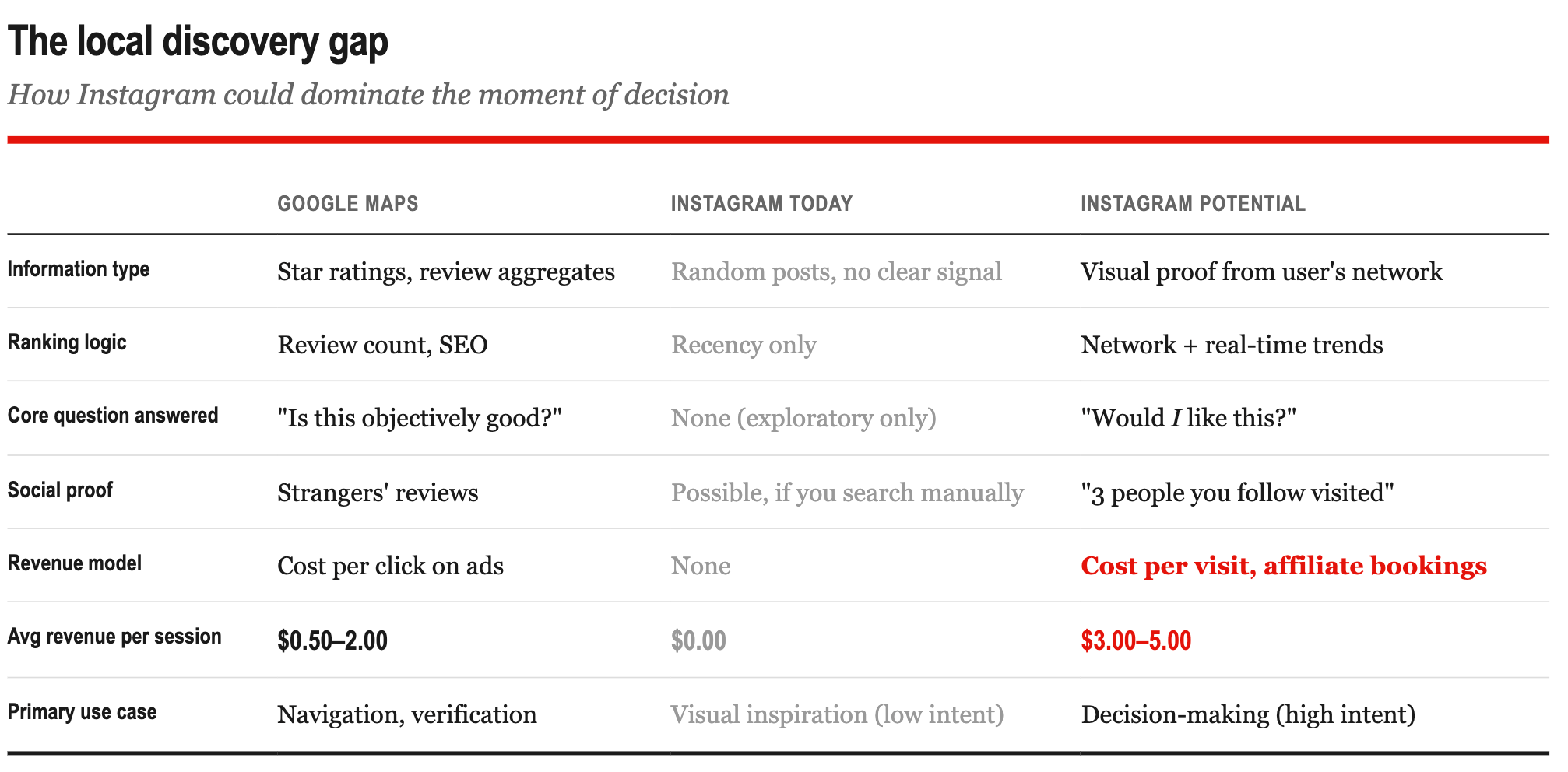
Makes a lot of sense
Love this !